
If you have dived in Candidasa before, please share your experiences: Dive spots you would recommend, which Dive Center you used, Fishes & Diving, Visibility, Currents, etc. Please post your comments in the section below, by doing so you will help fellow divers to plan their next trip

Candidasa’s signature dives are around Gili Tepekong, Gili Mimpang and Gili Biaha, off Bali’s east coast. Rocky scenery, fish schools and the possibility of reef sharks give these sites their character. The old guide’s enthusiasm is easy to understand: there can be plenty happening beyond the next boulder.
The practical detail matters just as much as the excitement. These offshore sites can have strong, changing currents and surge; they are not a default choice for a first ocean dive. Gili Selang is farther along the coast and should not be grouped as another small island immediately beside Candidasa. Regular hammerhead encounters are not established by the sources checked for this update.
In this page you will find more detailed information about scuba diving in Candidasa.
Table of contents
Best Dive Review
The three islets offer different profiles rather than one interchangeable “shark dive”. Tepekong combines walls and boulders with named areas such as the Canyon; Mimpang is a group of rocky outcrops; Biaha has dramatic walls and a well-known shark shelter. Overhead features are not an invitation to enter: training, conditions and the briefing determine the dive.
| Area | What stands out | Divezone detail |
|---|---|---|
| Gili Tepekong | Walls, boulders and schooling fish. | The Canyon · Plateau |
| Gili Mimpang | Rocky reef and current-dependent fish activity. | Mimpang site guide |
| Gili Biaha | Walls and possible whitetip encounters. | Biaha site guide |
Local operator’s site descriptions; PADI member-contributed Tepekong reference. Checked 9 November 2026.
The offshore islets and a neighbouring bay
These approximate geographic references help compare locations. They are not entry points, underwater navigation or a guide for use while diving. Gili Selang is a separate east-coast area, not a fourth islet beside Candidasa.
- Gili Tepekong (-8.53158, 115.58536): Island-area reference; several dive profiles surround the rock. Site reference
- Gili Mimpang (-8.53426, 115.56808): Offshore rocks also known as Batu Tiga. Site reference
- Gili Biaha (-8.50922, 115.61497): Separate islet farther along the coast. Site reference
- Blue Lagoon, Padang Bai (-8.52914, 115.51416): Neighbouring bay alternative, not one of the offshore islets. Site reference
How to dive Candidasa?
A Candidasa stay suits divers who want local boat outings without repeating a long daily drive from southern Bali. Day trips from other bases are also available, so the departure point and transfer inclusions make a real difference to the comparison.
A dated price example
Bali Hai publishes IDR 2,300,000 per person for its two-dive Tepekong/Mimpang programme, minimum two people, valid until 31 March 2027. It lists South Bali transfers, equipment, lunch, guide, porter and entrance fee among the inclusions. Its stated entry requirement is Advanced Open Water or equivalent plus at least 30 logged dives. That is this operator’s policy, not a universal permit to dive every site in every condition.
Programme price and requirements. Quotation and insurance terms still govern the booking.
A published two-site day trip
Bali Hai’s programme combines Gili Tepekong and Gili Mimpang after transfer to Padang Bai. The map illustrates that site grouping; numbers follow the programme listing, not a guaranteed visit order. The line is schematic and does not show a navigable boat track. Final sites depend on conditions. No fixed multi-day Candidasa cruise is implied.
| Programme | Listed dive locations | Access |
|---|---|---|
| Bali Hai two-dive day | Gili Tepekong / Gili Mimpang | Road transfer to Padang Bai, then dive boat; exact entries chosen locally. |
Operator programme, checked 9 November 2026
Programme details remain available in the table.
Where to stay?
I usually use this website to book in advance my hotels in Candidasa as they usually have the lowest rates I find. I like it because it's free to cancel and change the dates.

Best time to dive in Candidasa
Trips operate through the year when conditions allow, but a calendar cannot settle an offshore current assessment. July–October is a commonly cited sunfish window in local operator guidance, associated with cooler water; individual operators use somewhat different seasonal ranges. A sighting is a bonus rather than the measure of a successful dive.
Bali Diving’s seasonal overview · Crystal Divers’ local conditions. Checked 9 November 2026.

Top liveaboards in Candidasa according to divers reviews
Dive courses
Learning to dive while staying in Candidasa is different from learning at its exposed offshore islets. Local centres use a training pool and suitable open-water sites elsewhere. Lotus, for example, describes a three-day Open Water programme with pool training followed by dives around Tulamben and Padang Bai.
For certified divers returning after a break, a refresher or check dive provides useful information before committing to stronger-current sites. Southern Dreams explicitly requires a check dive for its Candidasa programme; certification alone does not establish recent comfort in moving water.
Training programme · Check-dive policy.
Scuba Diving conditions
Strong currents, including changes around the rocks and vertical water movement, are the important planning issue. A suitable boat crew, experienced local guide and conservative site choice matter more than a reassuring destination-wide label. A changed or cancelled offshore dive can be the right outcome.
Operators describe typical water around 26–29°C (79–84°F), with colder upwelling and thermoclines in the cooler season. A 3 mm suit is not a reliable universal recommendation here; exposure protection should match the current conditions and personal tolerance. Visibility varies and is not guaranteed to be excellent.
Water-temperature context; Local site selection and thermal-protection guidance.
Snorkelling in Candidasa
Companions who do not dive
Lotus Divers says most of its snorkelling trips run alongside dive trips, with equipment and support; dedicated snorkelling-only outings can be arranged for larger groups. This confirms a local option for non-divers, not automatic suitability for the exposed offshore rocks. The chosen site, supervision and passenger arrangements still need agreement.
No public companion tariff was verified on that page. A separate quote should state transport, equipment, guide coverage and any meals rather than assume a free boat place or a standard discount.
Operator snorkelling policy. A cooking class, yoga or a rice-field outing offers an alternative shore day; Lotus lists locally arranged activities. Checked 9 November 2026.
Fishes and Coral
The original trevally photograph is retained alongside five species illustrations from Divezone’s collection. These represent animals associated with the region; they are not six verified Candidasa capture locations or a sighting checklist. Reef sharks and fish schools share the stage with smaller reef life.

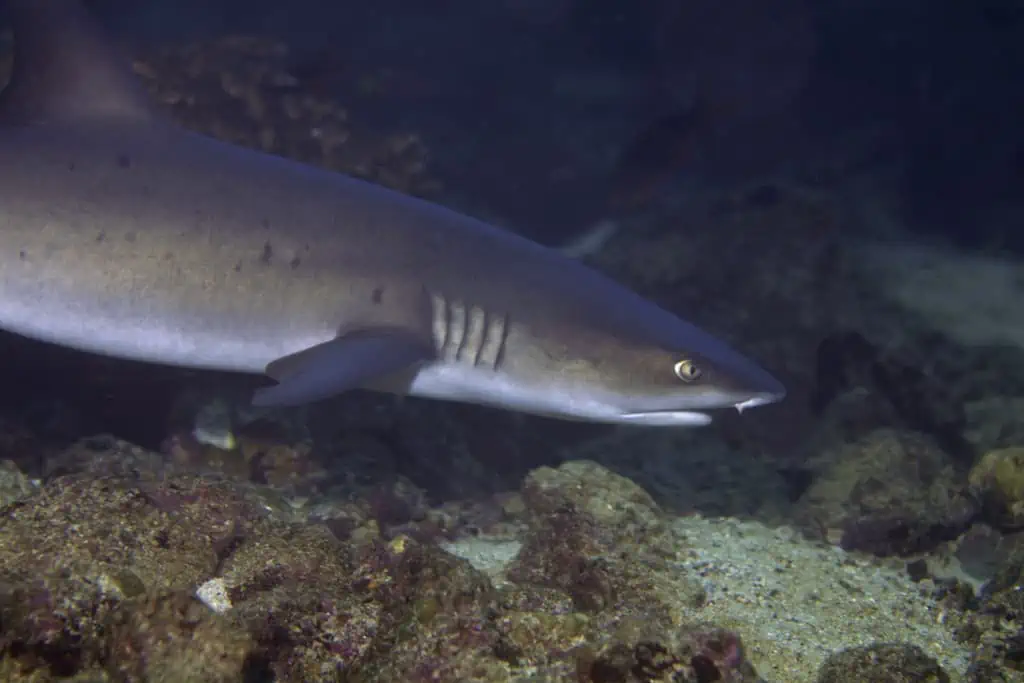
Whitetip reef shark
One of the characteristic reef-shark possibilities around the offshore islets.
Photo: Divezone species collection

Giant trevally
A powerful fish whose shape stands out against open water.
Photo: fugm10, original guide photograph
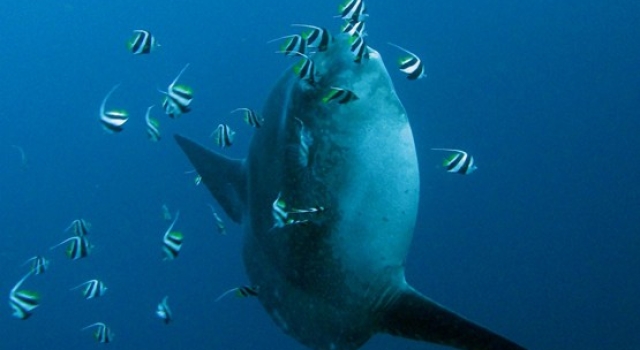
Sunfish
A seasonal possibility associated with cooler water, never a promised encounter.
Photo: Jihye Lee

Moray eel
Reef crevices deserve a patient look as well as the blue water.
Photo: Agnes Tjandranegara

Napoleon wrasse
A large reef fish reported in local site descriptions.
Photo: Divezone species collection

Barracuda
Another possible visitor around the walls and reef edge.
Photo: Divezone species collection
Original trevally photograph credit
A filmed dive at Gili Biaha
Film credited to Ludovic Amevor by Southern Dreams Diving Club. This records one visit, not guaranteed wildlife or a demonstration that overhead areas suit every diver.
Diving Safety
If you are planning an upcoming dive trip or travelling to Candidasa, it is a really good idea to invest in travel insurance for scuba diving, because you never know what could happen and when you might need it (because accidents do happen!). I recommend this diving insurance as they offer worldwide coverage and focus on providing scuba divers a quality insurance and medical assistance service.
Candidasa diving questions
Are Candidasa’s offshore dives suitable for beginners?
Tepekong, Mimpang and Biaha are generally treated as experienced-diver outings because of current and topography. Training while staying in Candidasa can use other, more suitable sites.
Are hammerhead sharks a regular attraction?
The current sources checked do not support that claim. Reef sharks are a more grounded possibility, and all wildlife remains unpredictable.
Is Gili Selang one of these three islets?
No. Gili Selang is a separate area farther along Bali’s east coast.
What experience does a day trip require?
Requirements vary. Bali Hai lists Advanced Open Water or equivalent and 30 logged dives for its Tepekong/Mimpang programme; another operator may require a check dive or apply different limits.
Can a non-diver come along?
Some local operators accept snorkellers on selected dive trips. The site, supervision, space and separate price need confirming; a free passenger place is not assumed.
Emergency oxygen, communications, evacuation arrangements and activity-appropriate insurance belong in the dive plan. Flights and inland altitude exposure need an appropriate post-dive interval. DAN guidance.
Original guide by Julien; refreshed 9 November 2026. Main image: original photograph credit. Reader comments retain their original dates and context.
Photos Candidasa

Travel Guide
Now that you know all about the underwater world, you might want to start planning your scuba holiday! Check out our Candidasa Travel Review for information about how to get there, activities and excursions, where to stay, and more.

I dived in Candidasa in early August this year. The dive was great, I saw a mola-mola, white-tip reef sharks and turtle here. There was also schools of snapper swimming around. There’s an abundance of fish. However, the current was really strong, most of the time I felt as though I am sitting in a washing machine, being pushed and pulled around. I was lucky to have an experienced dive guide with me. Also, please bear in mind that the water here is quite chilly in certain places, I had a 3mm wetsuit on me, still it felt cold most of the time.
Do you have any dive shop recommendations for Candidasa?
shangrila dive centre located at Bali palms candidasa best dive master in the area with over 2000 dives. best rate and best hotel rates.
Altough not very famous, sites here are super beautiful. Maybe it’s so beautiful beacause it’s not so famous, and only reserved for experienced divers.
Coral here has so divers shape, and you can spot turtles, sharks, molamolas.
Got to manage yourself in strong currents that can’t be resisted, prevent or escape early from getting caught in dangerous conditions such as down currents(bubbles or buddies going down), swell in caves.
Can’t forget Mimpang and Tepekong forever..
I dived there in the early ’90s. I don’t remember the details, but I do remember it was pretty good.