Kingston beneath the surface


Photographs published in Blue Force Fleet’s Kingston feature, May 2025. They show the site at the time photographed, rather than its condition on a future visit.
A shallow steamship with a reef worth lingering over
The Kingston wreck lies at Shag Rock in the Strait of Gubal, in Egypt’s northern Red Sea. For years divers called it Sarah H or Sara H; those names refer to the same wreck, not another ship nearby.
The coral along the hull offers wonderful photographic opportunities. This is a dive where the machinery, open framework and surrounding reef share the attention, rather than a tour of an intact ship. Shallow water brings light, but it does not remove the need to judge the current and surface conditions.
The ship and its loss
Kingston was a British cargo steamship built in 1871, approximately 78 metres long and 10 metres wide, carrying coal on its final voyage. It was lost at Shag Rock in February 1881. Historical summaries disagree on the precise sinking day: CDWS describes grounding on 22 February followed by sinking later, while Blue Force gives an earlier sequence. The month and year are more dependable than presenting one disputed date as settled.
What the dive looks like
The stern and midships are the most recognisable parts. CDWS describes an upright hull, propeller and rudder around 17 metres, exposed beams where wooden decks have disappeared, boilers and a spare propeller. The bow area is much more broken up against the reef. Its listed overall depth range is approximately 4–19 metres; your briefing should identify the actual profile for the day.
With suitable conditions, a visit can combine the wreck with Shag Rock’s coral slope. There is no universal direction or compulsory circuit: current, entry point and the pickup plan determine how much reef can sensibly be included. Remain outside enclosed spaces unless the dive is specifically planned within your wreck training and equipment.
Kingston: illustrated 3D overview
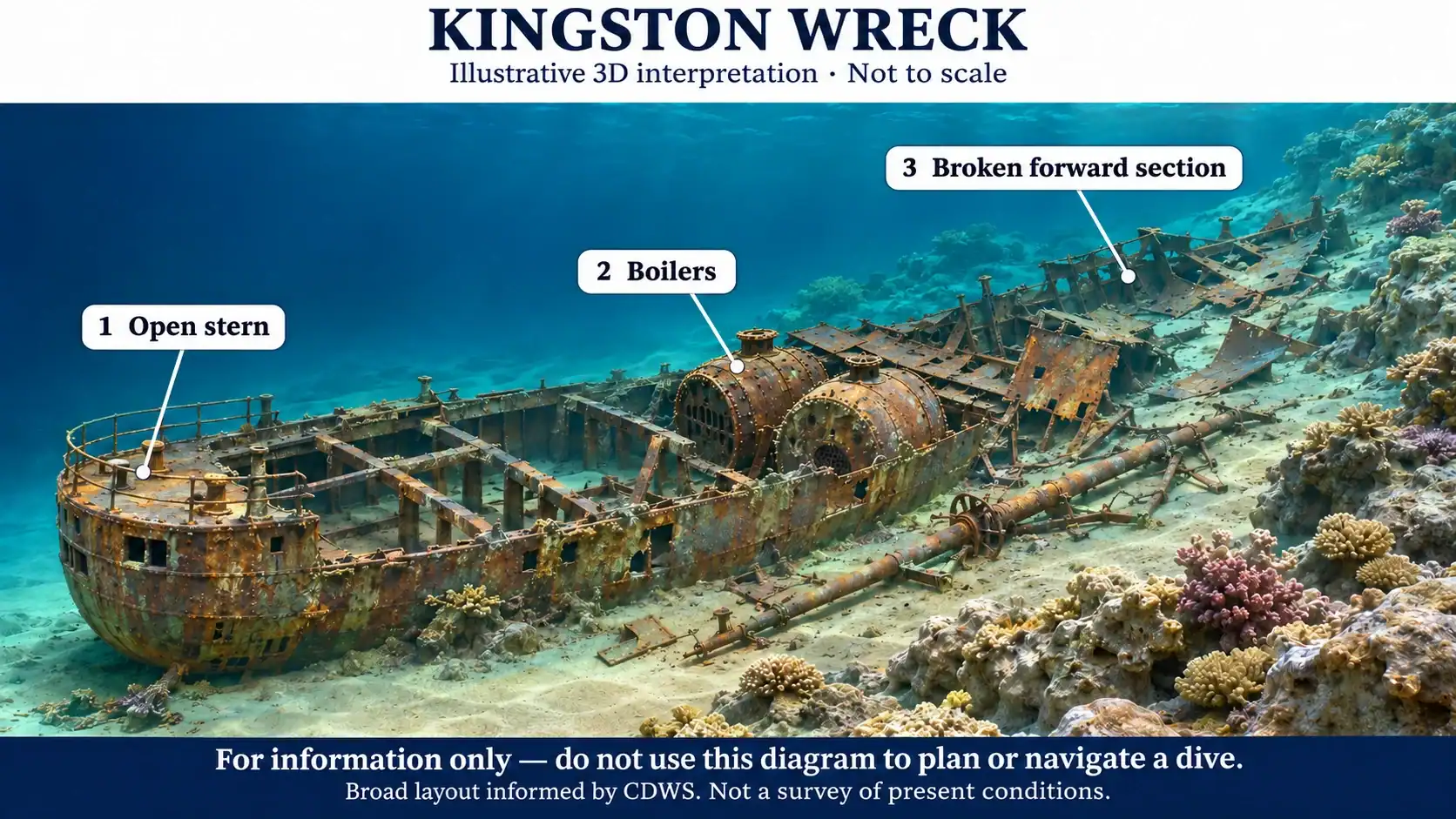
The surviving stern and open framework lead towards two boilers and the broken forward remains beside Shag Rock. Metalwork, reef texture and small fragments are illustrative.
For information only — do not use this diagram to plan or navigate a dive. It does not replace the licensed operator’s current briefing.
Reference: CDWS wreck illustration. The source informs the broad features; the artwork is not a measured survey.
Understanding the wreck’s layout
The bow meets Shag Rock’s reef slope, while the more recognisable stern lies farther down the slope. The exposed framework connects the remaining machinery and the coral-covered hull.
- Broken bow: fragmented remains against the reef.
- Boilers: two large boilers in the former engine-room area.
- Spare propeller: among the exposed remains, aft of the boilers in the published plan.
- Stern: the rounded hull, with the main propeller and rudder below; CDWS describes approximately 17 m here.
- Mast remains: off the wreck’s starboard side.
For information only — do not use this diagram to plan or navigate a dive. Positions and shapes are simplified, with no surveyed distances or entry/exit points. Confirm present conditions and remaining structures in the operator’s briefing.
Original Divezone illustration based on the undated wreck view and description published by the CDWS, inspected 4 November 2026. The image shows the broad relationship of the surviving stern, machinery and broken forward section; reef relief, beam spacing and small fragments are symbolic. It is not a survey or confirmation of present conditions.
Current, experience and photography
Emperor Divers warns that strong current is possible and recommends visiting only in good conditions. Do not assume the hull always provides shelter or that a shallow wreck is automatically suitable for every beginner. Comfortable buoyancy matters both around the metalwork and above the living coral.
The reef and coral growth are good reasons to bring a camera, but leave room for the group and keep fins and equipment clear of the wreck and reef. Turtles and passing pelagic fish are possible encounters, not fixtures of the dive. Nothing should be collected or disturbed.
Meet the reef
Life around Kingston
Coral growth softens the ship’s outline, and the fish often steal attention from the steelwork. These are documented encounters, not promises for a particular dive.
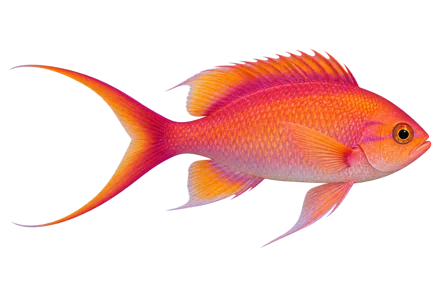
Anthias
Small orange fish bring movement to the coral-covered framework. Anthias are documented in Lawson Wood’s account and visible in Blue Force’s Kingston photographs. Pause above the reef with good buoyancy and let the scene unfold.
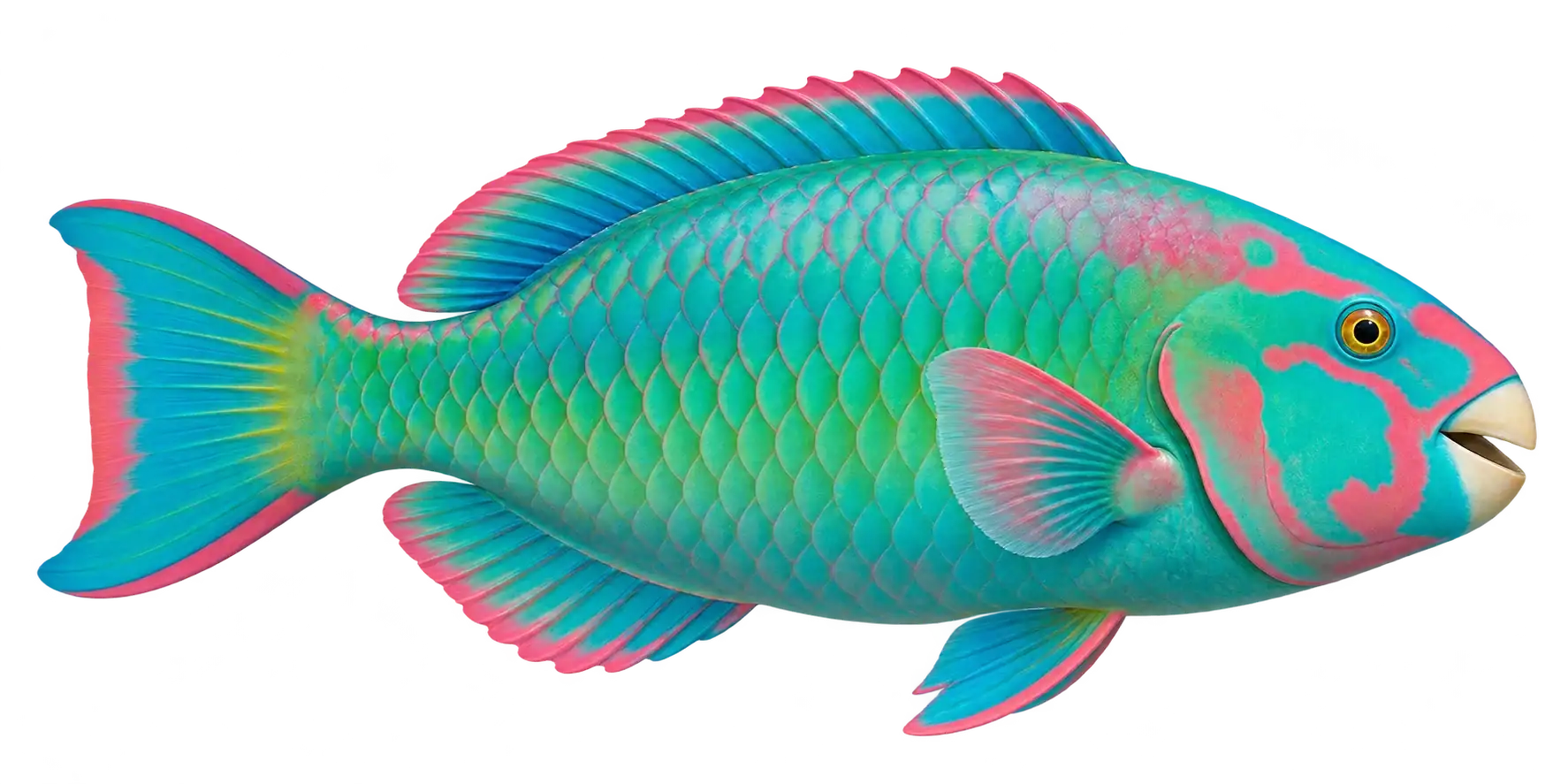
Parrotfish
Blue Force’s photographs show a parrotfish beside the encrusted beams. The living reef is as much a part of Kingston’s appeal as its machinery; give feeding fish space and keep fins clear of the coral.
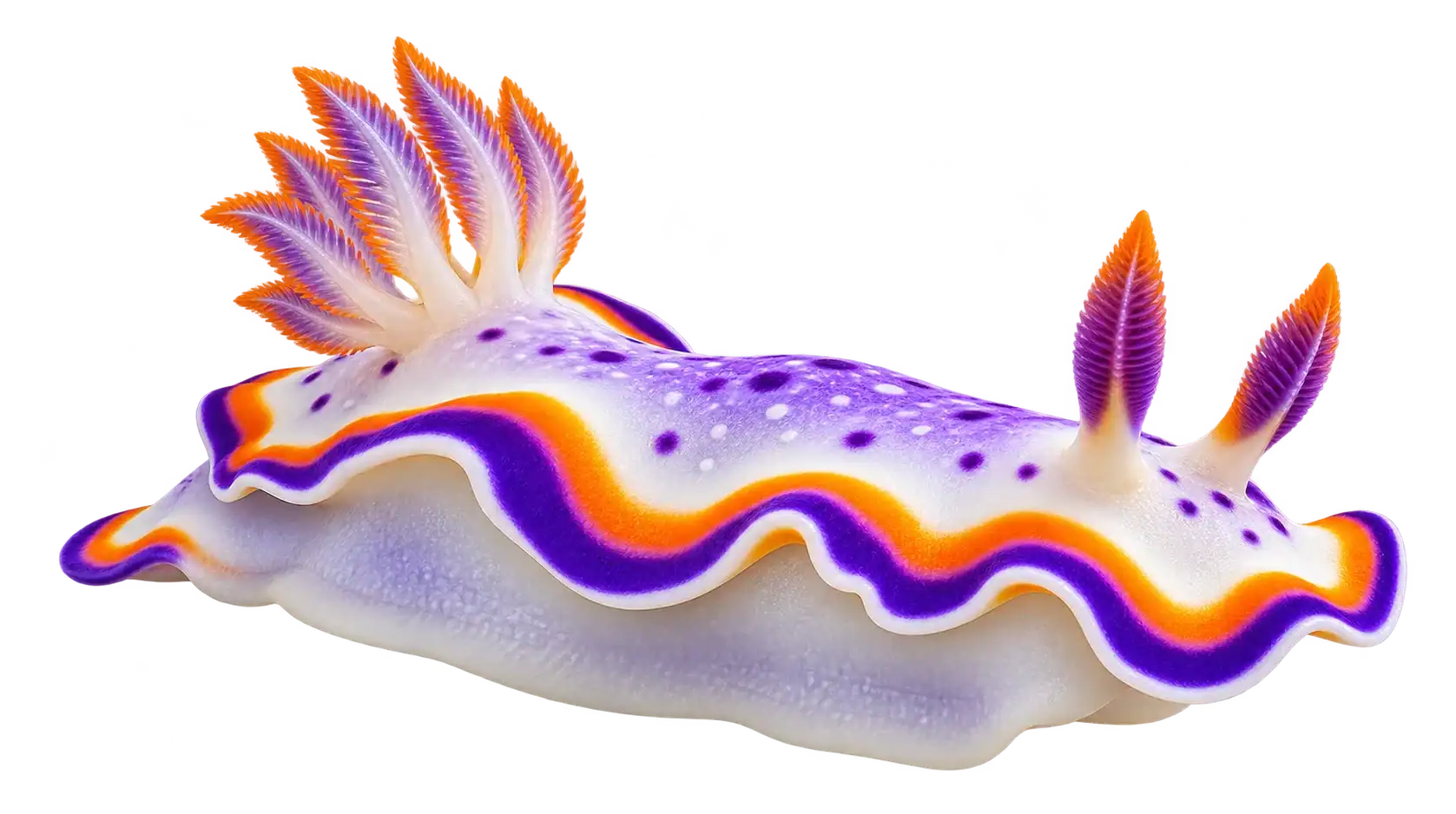
Nudibranchs
Lawson Wood documents nudibranchs here, including Spanish dancers and a pyjama nudibranch. Their size and camouflage reward a slower look at the reef. This representative illustration is not an identification of every species found at Kingston.
Other documented life includes Sohal surgeonfish around the wreck and sweetlips beneath its beams. Turtles have been reported along the surrounding reef, so an encounter should be treated as a possibility rather than part of the itinerary.
Illustrations represent animal groups and are not photographs of sightings. Site evidence: Lawson Wood’s Kingston account, June 2026, and the Blue Force photographs above.
Getting there
Kingston is reached by boat. Northern Red Sea liveaboards may include it, and Emperor lists it as a possible part of a Thistlegorm overnight trip. That is not confirmation of a daily excursion or a fixed crossing time from every Sharm marina. Ask whether Kingston itself is scheduled and what happens if conditions prevent the dive.
A mixed group should confirm whether non-divers are accepted, the passenger fare and any supervised snorkelling at the actual stops. A shallow wreck does not establish that its boat operation is suitable for snorkellers.
Location reference
The CDWS directory places Shag Rock (Kingston) at 27°46′26″ N, 33°52′14″ E, or approximately 27.773889° N, 33.870556° E. This reef-site reference is not an entry point, mooring or navigation instruction.
Open a larger area map on OpenStreetMap ↗
Kingston in a northern wreck film
Aqualized’s The Famous North Red Sea Wrecks, uploaded in December 2009, includes Kingston in a wider compilation with Carnatic, Giannis D, Chrisoula K, Kimon M and Dunraven. It gives historical context for a northern wreck safari; the entire film is not Kingston. Older footage does not establish today’s wreck condition, access or suitable dive profile. Treat any enclosed-space sequences as specialist diving, not a recreational route to copy.
Film and preview: aqualized · The Famous North Red Sea Wrecks on Vimeo.
Kingston wreck questions
Is Sarah H a different wreck?
No. Sarah H and Sara H are older names used for the Kingston wreck at Shag Rock.
How deep is Kingston?
CDWS lists roughly 4–19 metres, with the stern propeller and rudder around 17 metres. Operator descriptions vary; use the actual briefing and your own depth limit.
Is it always an easy second dive?
No. Strong current and exposed surface conditions can change suitability. Its shallow depth alone does not determine difficulty or your dive sequence.
Is the ship intact?
No. Recognisable stern and machinery remain, but the superstructure and decks are missing and the bow area is broken up.
Can I book a regular Sharm day trip?
Confirm a specific departure. A documented option is inclusion in an operator’s Thistlegorm overnight programme; this does not prove a daily Kingston excursion.
Can non-divers snorkel over it?
Do not assume so. Ask about passenger acceptance, price, conditions and a supervised snorkelling programme for the exact boat and day.
Sources
Depth, principal wreck features and Emperor’s access description rechecked 3 November 2026; photograph and schematic sources are credited alongside those sections.
Checked 24 October 2026: CDWS wreck description; CDWS coordinates; Emperor access and conditions; Blue Force history and photography.
Share your visit date, conditions, encounters and advice for the next diver.
You can dive Kingston Wreck all year long. Access: Boat. See the map of Kingston Wreck on the right for the exact location.
Fishes you may spot while diving Kingston Wreck
-
 Nudibranch
-
 Parrotfish
-
 Surgeonfish
-
 Sweet Lip
-
 Turtle
... and more fishes & sea life, Anthias

Photos
-
 Blue Nudibranch in Lembeh StraitPhoto by Rich Guest
-
 Spiked Yellow White Black NudibranchPhoto by Jihye Lee
-
 White Nudibranch Reef Lembeh Strait ReefPhoto by Jihye Lee
-
 School Of Sweet LipsPhoto by Jihye Lee
-
 Closeup NudibranchPhoto by Jihye Lee
-
 Beige Blue White NudibranchPhoto by Rich Guest
-
 White Orange Shaped NudibranchPhoto by Jihye Lee
-
 White Nudibranch Reef Koh Lanta ReefPhoto by Rich Guest
-
 White Black NudibranchPhoto by Jihye Lee
-
 Strange Looking NudibranchPhoto by Jihye Lee
Diving Reviews for this region

Sharm El Sheikh
Sharm combines local reef diving with Ras Mohammed, Tiran and separately planned wreck excursions. Match the route and dive profile to your experience.
Liveaboard Reviews in Sharm El Sheikh

MV Seawolf Dominator
A shaded dive deck, room to relax outside and a choice of northern and southern programmes make Dominator an appealing base for a week devoted to diving. Choose the route first: a Tiran week and a marine-park week ask different things of a diver.
MV Blue Melody
Blue Melody suits divers who enjoy the rhythm of a shared diving holiday: breakfast after the first dive, a long conversation over lunch, then time outside before the next briefing. The outdoor bistro and shaded seating are part of the attraction, with
MV Snefro Love
A few nights aboard can fit neatly into a longer Sinai holiday. Snefro Love makes that possible with short wreck-and-reef safaris from Sharm el Sheikh, as well as week-long programmes. Between dives, the salons and outdoor decks give a group of up to t
Freedom VIII
Freedom VIII is a 22-metre liveaboard for up to eleven guests, sailing from Umbi Sharks Bay in Sharm El Sheikh. Five cabins and a choice of shorter safaris make it an appealing size for friends who would rather share a boat than join a large group. Its
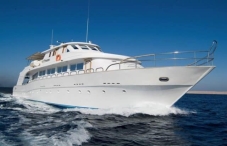
MV Dreams
No dated departure was available online for the earlier MV Dreams when checked on 5 November 2026. This 28-metre, sixteen-guest boat is distinct from Serena Dreams. Its smaller scale was an alternative to the larger Red Sea safari boats; this page pres
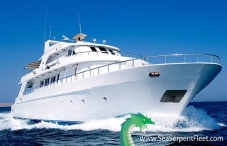
MY Miss Nouran
This review concerns the earlier MY Miss Nouran, described with ten air-conditioned cabins for twenty guests and a refit in 2008. It is separate from Glorious Miss Nouran and should not supply that vessel’s specifications.

MY Dreams Liveaboard
The earlier MY Dreams was a 28-metre liveaboard with eight en-suite cabins accommodating up to sixteen divers. Its documented northern programmes included Sinai reefs, the Straits of Tiran and Abu Nuhas; these are past programme descriptions, not confi
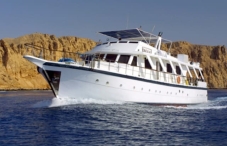
MY Ghazala I
No current dated departure has been verified for the Ghazala I described here. Its specialist listing checked on 2 November 2026 says it is not currently available. That alone does not establish permanent retirement.
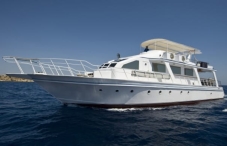
MY King Snefro 5
No current dated departure has been verified. LiveAboard.com shows no online availability when checked on 2 November 2026. The previous October research also found specialist descriptions saying that King Snefro 5 no longer operates, alongside older re
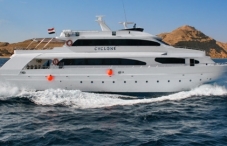
MY Cyclone
This archive covers the older MY Cyclone, not the newer Cyclone Explorer. The specialist listing for the earlier boat remains unavailable when checked on 2 November 2026.